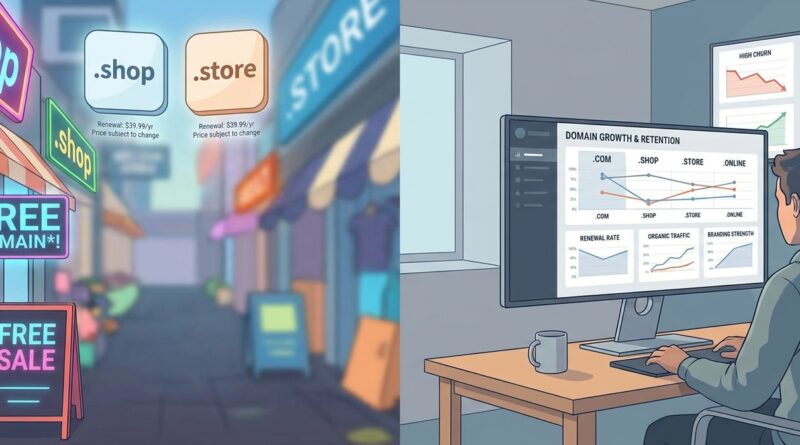
The .SHOP Reality Check: Why Cheap Store Domains Look Tempting But Rarely Build Lasting Value
You finally find a name that fits your store, and of course the .com is taken. Then a registrar waves a shiny little offer in your face. YourBrand.shop for $1.99. Problem solved, right? That is exactly where a lot of founders get tripped up. The first-year price feels painless, especially when you are juggling ads, packaging, inventory, and about seventeen other startup costs. But the real test is not checkout day. It is renewal day. That is when some of these domains jump from cheap to oddly expensive, while your traffic, type-ins, and customer trust may still be flat. So if you are asking is a .shop domain worth it in 2026, the honest answer is, sometimes. But only in a narrow set of cases. For many small brands, .shop, .store, and .online are less of a branding shortcut and more of a one-year rental that never turns into a real long-term asset.
⚡ In a Hurry? Key Takeaways
- A .shop domain can work in 2026, but it is usually not the best long-term choice unless it fits your brand perfectly and the renewal cost is stable.
- Before you buy, check the renewal price for three years, not just the intro price, and ask whether customers will remember and trust the extension.
- Cheap first-year domain deals often hide weak long-term value, so do not build your best brand on an address you may not want to keep.
The real question is not “Can I buy it?”
The real question is, “Will this domain still make sense in three years?”
That sounds boring. I know. But domains are one of those quiet business decisions that age either really well or really badly.
A cheap commerce extension can look smart on day one. It can also become dead weight by year two if customers forget it, mistype it, or assume your .shop site is the backup version of a “real” .com.
This does not mean .shop is useless. It means you have to judge it by what it helps you keep, not what it helps you save in the first ten minutes.
So, is a .shop domain worth it in 2026?
For most businesses, only if all three of these things are true:
- The name is short, brandable, and clearly improved by “.shop”
- The renewal cost is reasonable and predictable
- Your audience is likely to see the full domain in social bios, ads, or creator content, not just hear it once and try to remember it later
If even one of those is shaky, the value drops fast.
This is why a lot of registrations happen, but a lot of renewals do not. People buy on impulse because the price is low and the name feels available. They renew only if the domain actually starts pulling its weight.
Why these domains feel like a bargain
Year-one pricing is built to feel harmless
$0.99. $1.99. Maybe $4.99 with privacy thrown in.
That is not an accident. Registrars know a low first-year price removes friction. When you are naming a side hustle or testing a product idea, the domain barely feels like a decision at all.
But domains are not one-time purchases. They are subscriptions with branding consequences.
“Available” feels emotionally valuable
This matters more than people admit. After seeing ten taken .com names in a row, finding your exact brand on .shop feels like a small victory. You want the search to be over.
That relief can cloud your judgment.
It is the same reason people overpay for airport snacks. You are not just buying the thing. You are buying the end of frustration.
Where the trap usually shows up
Renewal pricing
The biggest surprise is often the second invoice.
A domain that cost pocket change to register can renew at a price that makes you pause. Not always outrageous, but high enough that you start asking, “Do I even want this anymore?”
That question is the warning sign.
If your domain does not feel obviously worth renewing after one year, it probably was not building much long-term value in the first place.
Weak direct navigation
Most small brands do not get much “type-in” traffic anyway. People click links from Instagram, Google, TikTok, email, and marketplaces.
Still, domain memory matters.
If someone hears your brand on a podcast or from a friend, are they likely to guess the address correctly? Many will still default to .com. Some will search instead. Some will give up.
That extra friction is small, but it adds up over years.
Trust and legitimacy signals
This one is subtle.
Plenty of normal people do not know what a TLD is, but they do notice whether a web address feels familiar. .com still carries a trust advantage simply because it is boring and expected.
.shop can look clean for a modern store. It can also look temporary if the rest of the branding is weak.
In other words, the extension does not rescue a mediocre brand. It only supports a strong one.
When .shop actually does make sense
There are real use cases where .shop is not just acceptable, but smart.
1. The domain reads like a complete brand
If the left side and the extension work together naturally, that can be effective.
Think something like candle.shop, vintagevinyl.shop, or maker.shop. Short. Clear. Easy to say.
When the extension feels like part of the name, memorability improves.
2. You sell mostly through social and paid traffic
If your audience mainly taps links instead of typing your domain from memory, the extension matters a little less.
This is why some direct-to-consumer brands and creator-led shops can get away with alternative endings more easily than local service businesses can.
If your store lives in TikTok bio links, Instagram stories, and creator collabs, a .shop can fit the flow better than it would for a law office or accountant.
If you want the more optimistic side of that case, this piece on The Quiet .SHOP Surge: Why E‑Commerce Founders Are Grabbing This ‘TikTok‑Native’ Extension Before Q4 2026 explains why some founders still like it.
3. You already own the .com, and .shop is secondary
This is a very different situation.
If you own YourBrand.com and use YourBrand.shop for a campaign, a product drop, or a storefront shortcut, that can be useful. In that case, .shop is not carrying your whole identity. It is supporting it.
That is much less risky.
When .shop is usually a bad bet
1. You are using it because it is the only cheap option left
This is the most common mistake.
If the name is average, the extension is doing too much work. You are not building a sharper brand. You are settling for an available checkout button.
2. The renewal price is much higher than the first-year price
If you would hesitate to pay the renewal price today, do not register it.
That simple rule will save people a lot of money.
3. Your business depends on word of mouth
If customers need to remember your domain after hearing it once, .com still wins more often.
Say the name out loud. If you have to explain “dot shop, not dot com,” that is not a great sign.
4. You hope the extension itself will make you look modern
Customers care more about trust, design, speed, reviews, and checkout ease than about clever domain endings.
The extension can help a little. It cannot carry the business.
A simple test before you buy
Ask these five questions:
- What is the exact renewal price after year one?
- Would I still want this domain if it cost that amount today?
- Can someone hear it once and type it correctly later?
- Does the extension improve the brand, or just solve availability?
- If this business works, will I still be proud to print this domain on packaging in five years?
If you stumble on two or more of those, pause.
What small brands should do instead
Option 1. Buy a better .com, even if it is slightly longer
A clean, easy .com that is one word longer is often a better asset than a perfect one-word .shop.
Examples: getbrandname.com, shopbrandname.com, brandnameco.com.
Not glamorous. Often effective.
Option 2. Use .shop for testing, but do not marry it
If you are validating a product idea, a .shop domain can be a low-cost test bed. That is fine.
Just be honest with yourself that you are testing, not planting a flag for the next decade.
Option 3. Secure multiple domains only if the math makes sense
Sometimes the smart move is to buy the .shop now, keep watching for the .com, and plan a future switch.
But do not turn domain buying into a collecting hobby. If you are paying renewals on five versions of the same idea, your “cheap” domain strategy is no longer cheap.
Why renewal behavior tells you a lot
One of the clearest signals in the domain world is whether people keep what they buy.
Strong long-term extensions tend to have better renewal patterns because owners feel real attachment and utility. Weak renewal behavior usually points to speculative buying, promo chasing, or low satisfaction after the first year.
That matters because a domain is not just a label. It is supposed to become an asset. If huge numbers of people quietly drop similar names after year one, that should tell you something.
It suggests many of these purchases felt better at checkout than they did in real life.
At a Glance: Comparison
| Feature/Aspect | Details | Verdict |
|---|---|---|
| First-year cost | Usually very low, often designed to attract impulse registrations | Good for testing, not proof of long-term value |
| Brand trust and memory | Can work for modern e-commerce brands, but many users still assume .com first | Mixed. Strong only when the brand-extension fit is excellent |
| Renewal and staying power | Renewal pricing and weaker keep-rates make many owners rethink the purchase after year one | Big caution sign for budget-conscious founders |
Conclusion
If you are asking is a .shop domain worth it in 2026, the safest answer is this. It can be worth it for a small slice of brands, but it is not the automatic fix people hope for when the .com is gone. Commerce extensions are growing fast, yet many also get dropped fast. That tells you plenty. A low entry price is nice, but it does not mean the name will age well, earn trust, or deserve renewal after renewal. For side hustlers, indie brands, and small teams, the smart move is to treat a domain like a long-term business asset, not a checkout impulse buy. If a .shop name truly strengthens your brand and the renewal cost is fair, great. If not, save your best idea for an address that can keep compounding in value over the next decade instead of quietly expiring after one enthusiastic year.