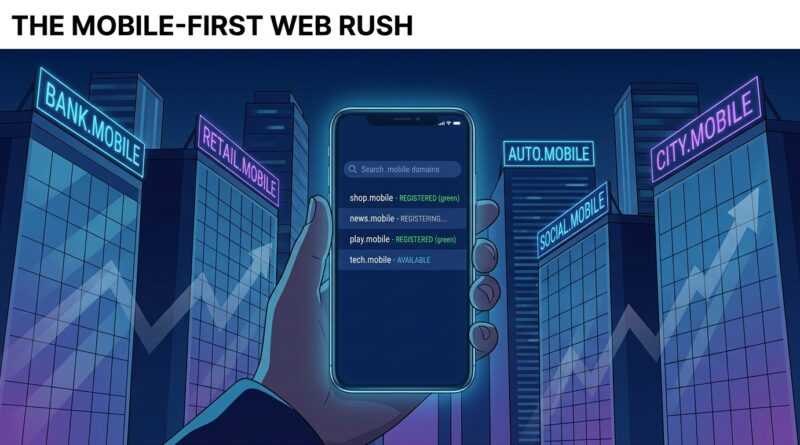
The .mobile Moment: How A ‘Phone‑First’ TLD Quietly Became 2026’s Hottest New Address
You can feel it when a brand name looks awkward on a phone. Too long. Too crowded. Hard to read in a tiny browser bar, a social bio, or a paid ad. That is the frustration a lot of founders are sitting with right now. They built for mobile users, but their web identity still feels stuck in desktop-era .com thinking. Now the market is shifting. .mobile has quietly moved from niche curiosity to one of the most watched new web addresses of 2026, and that matters because the good names do not stay available forever. If your audience lives on phones, the dot mobile domain value question is no longer a theory exercise. It is a timing question. Buy the right names early, use them in real campaigns, and you get clarity, memorability, and cleaner branding. Wait too long, and you may end up paying more for weaker options.
⚡ In a Hurry? Key Takeaways
- .mobile is gaining real market value because it fits short, tap-first branding better than many overloaded .com names.
- Start by buying your brand match, your top campaign phrase, and one short defensive variation before prices and renewals climb.
- Do not treat every .mobile like a gold mine. Names with clear mobile use, short length, and strong buyer fit have the best odds of holding value.
Why .mobile suddenly matters
Most people do not type web addresses on full-size keyboards anymore. They tap. They swipe. They glance. That changes what makes a domain useful.
A strong .com is still powerful. Nobody needs to pretend otherwise. But many great .com names are long gone, overpriced, or padded with extra words that make a brand feel less sharp on mobile. That is where .mobile has found its lane.
It tells the user something fast. This is built for your phone. This is simple. This is current. For apps, mobile commerce, creators, booking tools, fintech, delivery, gaming, local services, and direct-response campaigns, that message can be worth real money.
What drives dot mobile domain value
Not every .mobile name is valuable. Some will sit unused. Some will never attract a serious buyer. The trick is knowing what the market actually rewards.
1. Short names win
The shorter the name, the better it tends to perform. That is especially true on mobile screens, where every extra character makes a name feel heavier. One-word brands, two-word phrases with clean rhythm, and short call-to-action names are the sweet spot.
Think in terms of names that fit naturally in a text message or ad creative. If it feels annoying to say out loud, it is probably too clunky.
2. Clear mobile intent matters
The best .mobile names have an obvious use case. Food.mobile, rides.mobile, pay.mobile, book.mobile, scan.mobile. Even if those exact names are not available, the pattern is what matters. Users and buyers should instantly understand why the name belongs on .mobile and not just any extension.
3. Brandability beats keyword stuffing
A clean brand name usually beats a robotic exact-match phrase. Yes, search terms still matter. But people remember names that sound like something they would actually tap. A name like Swift.mobile is easier to build around than BestCheapPhoneInsuranceDeals.mobile.
4. Commercial use beats novelty
If a domain can support a real business model, it has a better chance of holding value. Payments, bookings, local lead generation, affiliate funnels, app landing pages, premium SMS campaigns, QR-driven promotions, and mobile storefronts all make sense here.
How to compare .mobile against .com without kidding yourself
This is where people get emotional. Some investors act like every new extension will replace .com. It will not. Others dismiss anything outside .com as worthless. That is lazy thinking too.
Here is the simpler view. .com is still the strongest general-purpose standard. .mobile is a specialist. Specialists can be extremely valuable when the fit is right.
When .com is still the better buy
If you are building a broad, long-term company and can get a strong .com at a sane price, that is usually the safer anchor asset. It travels better across markets, age groups, and trust levels.
When .mobile may be the smarter move
If your users mostly come from phones, if your campaign lives in social apps, if your call to action is tap now, scan now, book now, shop now, then .mobile can do something a mediocre .com cannot. It can feel made for the moment.
That is the heart of dot mobile domain value. It is not about replacing .com. It is about beating awkward .com compromises in mobile-heavy use cases.
The best .mobile buying patterns right now
If you want a tactical playbook, start here.
Brand match
Buy your exact brand in .mobile if it is available. Even if your main site stays on .com, this gives you a strong campaign asset and stops someone else from using your name in a phone-first setting.
Action domains
These are verbs and commands tied to conversion. Examples include book, shop, scan, join, pay, order, stream, track, and start. They are useful because they fit ads, QR codes, and landing pages.
Category plus city
For local businesses and lead gen, patterns like DentistDallas.mobile or TaxisMiami.mobile can work if they are readable and commercially useful. Keep them tight. If the phrase gets too long, the benefit drops fast.
Product plus audience
Think around real use. BudgetTravel.mobile, StudentBanking.mobile, PetCare.mobile. These can be strong if the niche spends money and the name is still easy to read.
Defensive misspellings, sparingly
Only buy variations that protect obvious confusion. Do not go wild. Defensive registration should be a seatbelt, not a shopping spree.
How to use .mobile in live campaigns
This is where many people miss the point. A domain is not just a collectible. It should do a job.
Use it for paid social landing pages
A short .mobile domain can look cleaner in Instagram, TikTok, YouTube, and mobile display campaigns. It feels native to the device people are already holding.
Use it with QR codes
QR campaigns work better when the destination feels obvious and trustworthy. A short .mobile address is easier to print, remember, and explain after the scan.
Use it for app-adjacent traffic
If you are promoting an app, a .mobile landing page can act as a simple bridge page with download links, support, promo codes, and onboarding steps.
Use it for SMS and creator promos
Text messages and creator shout-outs reward brevity. A short .mobile domain can be easier to read aloud and easier to type without mistakes.
What to avoid before you spend money
Hype makes people sloppy. A few guardrails help.
Do not overpay for weak names
If the phrase is long, confusing, or has no clear commercial use, the extension alone will not save it.
Check renewal pricing
Some new extensions have low first-year prices and much higher renewals. That can wreck your math if you plan to hold names for several years.
Watch trademark risk
Do not buy names that clearly step on existing brands. That is not investing. That is asking for trouble.
Do not assume resale will be easy
Value depends on actual buyer demand. Buy names you would be comfortable using yourself if no one ever offered to buy them.
A simple valuation framework for .mobile
If you are trying to put a number on a .mobile name, use four basic questions.
First: Is it short and easy to say?
Second: Does it make obvious sense on mobile?
Third: Is there real commercial demand behind the term?
Fourth: Could a business use it in a campaign tomorrow?
If the answer is yes to all four, the name has solid potential. If only one or two are true, keep your wallet in your pocket.
This same careful approach is useful in other extension trends too. If you want a good example of how niche web addresses can create upside before the crowd piles in, read The Quiet .DOT Experiment: Why This ‘Meta’ Extension Could Be 2026’s Smartest Asymmetric Bet. Different extension, same lesson. Context matters more than hype.
Who should move first
You do not need to buy dozens of domains to benefit from this trend. But a few groups should pay attention now.
Founders
If your traffic is mostly mobile, secure your exact-match .mobile and one campaign variant.
Brand builders
If you run launches, short promos, influencer pushes, or QR campaigns, test a .mobile landing flow against your current setup.
Domain investors
Focus on quality over volume. One strong, obvious .mobile can beat a pile of random registrations.
Agencies
If you handle direct response, local acquisition, or app installs, .mobile can be a useful client-facing tool, not just a speculative asset.
At a Glance: Comparison
| Feature/Aspect | Details | Verdict |
|---|---|---|
| Brand fit | .mobile works best for phone-first products, campaigns, apps, and mobile commerce. .com stays broader and more universal. | Use .mobile when mobile intent is obvious. |
| Value potential | Short, commercially useful names with clear mobile use have the strongest upside. Weak generic names do not magically gain value from the extension alone. | Be selective. Quality matters a lot. |
| Best use today | Paid campaigns, QR destinations, app landing pages, social bios, and SMS-friendly calls to action are natural fits. | Strong tactical tool, especially while still underpriced. |
Conclusion
.mobile is not a magic trick. It is a tool, and right now it is a tool with growing demand, shrinking availability, and a very clear use case. That is why this matters today. .mobile has now been confirmed as the best-selling new domain string for the mobile-first economy, which means good names may not stay cheap or open for long. If you get practical about dot mobile domain value now, buy the right patterns, compare them honestly against .com, and put them to work in real campaigns, you give yourself an edge while bigger media outlets are still barely noticing the shift. For founders, investors, and brand builders, that kind of head start is often where the best opportunities live.