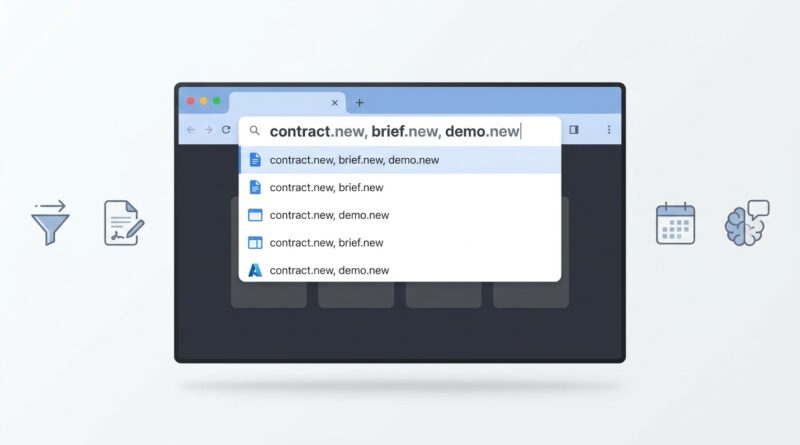
The Quiet .NEW Land Rush: Why Google’s Workflow TLD Just Became 2026’s Most Underrated Power Move
You know that tiny moment of embarrassment when you send someone a link like companyname.typeform.com/to/lead-intake-v4-final2 and then have to explain what it is, whether it is safe, and why they should click it. That is the real problem most teams still have. Not branding. Not hype. Just ugly, forgettable URLs that make everyday work feel harder than it should. The quiet appeal of the .new domain extension is that it fixes that pain in a very human way. It turns a web address into a clear action. Think quote.new, demo.new, onboard.new, or invoice.new. You click, and something starts. That matters even more now that ICANN’s 2026 gTLD round has pushed companies to think bigger about domains again. While everyone else is daydreaming about the next hot extension, .new is already here, already trusted, and already useful for real workflows, customer handoffs, internal tools, and AI-assisted tasks.
⚡ In a Hurry? Key Takeaways
- The .new domain extension is most useful when you want a link to start an action instantly, not just open a homepage.
- Use short .new names for things people repeat often, like booking demos, opening tickets, creating docs, or launching an internal tool.
- Because .new is run by Google and has strict usage rules, it carries trust, but you still need clear redirects, HTTPS, and a simple destination experience.
Why .new suddenly matters more in 2026
The timing is not random.
ICANN has kicked off the 2026 new gTLD round, and that changes the mood of the market. People are not just asking, “What domain should I buy?” They are asking, “What kind of domain system should I build around my business?” That is a much bigger question.
And it puts a spotlight on extensions that already do something useful today.
The .new domain extension is one of the clearest examples. Google operates it with a simple idea. A .new address should kick off an action fast. Not act like a digital brochure. Not send people into a maze of tabs and menus. Just start the task.
That makes it feel less like a normal domain and more like a button you can type.
What .new actually is, in plain English
If a regular domain is an address, a .new domain is more like a shortcut.
That is the easiest way to think about it.
When someone types a .new URL, the expected result is immediate action. Create a new file. Start a form. Launch a request. Open a chatbot session. Begin an onboarding flow. The name itself tells the user what comes next.
That is why examples like doc.new or playlist.new make instant sense. The word and the action line up.
For businesses, that opens up a very practical playbook. You can register simple, memorable words and point them to workflow entry points that people use every day.
The real value is not hype. It is less friction.
Most business links are terrible.
They are long. They are buried on subdomains. They look temporary even when they are important. They make customers hesitate, and they make employees rely on bookmarks, Slack messages, or “can you resend that link?”
A good .new address fixes several of those problems at once.
It is easier to remember
quote.new is easier to remember than sales.company.com/forms/request-a-custom-estimate.
It explains itself
If you send someone invoice.new, they already know the job of the link before they click.
It works well in speech
You can say it in a meeting, on a podcast, or in a sales call without spelling out a monster URL.
It cuts down on context
You do not need three sentences of explanation every time you share it.
Why founders and operators should care
This is where the .new domain extension gets underrated.
You do not need to own a custom registry. You do not need a seven-figure .brand strategy. You do not need to wait years for a shiny new string to launch and then hope people adopt it.
You can use what already exists.
That is the power move here. .new lets smaller teams borrow some of the clarity and trust that usually only giant brands can create for themselves.
Because Google runs the extension, there is a built-in sense that this is not some random sketchy corner of the web. That does not mean every .new site is automatically brilliant, of course. But it does give you a stronger starting point than a confusing link on an obscure subdomain.
If you have been watching the wider domain market, this fits a broader pattern. As we noted in Beyond .ai: The Five New gTLD Verticals Quietly Breaking Out Ahead of ICANN’s 2026 Round, the interesting action is no longer just about buzzworthy endings. It is about extensions tied to real behavior and real use cases.
Best use cases for a .new domain extension
Not every link deserves a .new address.
The sweet spot is repeatable action. Things people do often. Things that benefit from speed and clarity.
Sales funnels
Use names like demo.new, quote.new, consult.new, or apply.new to send prospects into a clean conversion path.
If your current call to action lives behind a clunky URL, this is one of the easiest upgrades you can make.
Internal tools
Think expense.new, hire.new, incident.new, brief.new, or sprint.new.
These are the kinds of links employees can remember without opening an old wiki page.
AI copilots and assistants
This is where things get especially interesting.
If your team has a support bot, writing helper, proposal generator, or internal Q&A tool, a .new domain can become the natural front door. Ask.new. draft.new. reply.new. summarize.new. It feels obvious because it is action-first by design.
No-code apps
If you built a useful little workflow in Airtable, Glide, Retool, Softr, or another no-code stack, a good .new name can make it feel more permanent and more approachable.
That matters when you want people to actually use the thing.
How to choose a good .new name
Short is good. Clear is better.
The best .new names usually follow one of three patterns.
1. Verb-based
book.new, start.new, send.new, file.new, plan.new
These work well when the action is broad and obvious.
2. Outcome-based
demo.new, invoice.new, brief.new, quote.new, ticket.new
These work when the user cares more about the result than the verb.
3. Team-specific
salesdemo.new, hrrequest.new, partnerlead.new
These are less elegant, but sometimes more practical inside a larger company.
The big rule is simple. If you have to explain the link every time, the name is not doing enough work.
What to watch out for
.new is useful, but it is not magic.
Do not send people to a messy destination
If the destination page is cluttered, slow, or asks users to hunt for the next step, you lose the whole point of using .new.
Keep redirects clean
Test them often. A memorable link that lands on an error page is worse than an ugly link that works.
Make the first screen obvious
When someone arrives from a .new URL, they should know within seconds what to do next.
Check policy and registrar availability
Because .new is meant for action-oriented use, usage expectations can be stricter than with some generic extensions. Make sure your intended use fits the spirit and rules of the namespace.
Why this fits where the web is going
The old web trained us to think of domains as places.
The next version of the web looks more like prompts, agents, shortcuts, and triggers.
That is why the .new domain extension matters beyond clever branding. It teaches people a new habit. Type an action. Start a workflow. Get something done.
This lines up neatly with browser-integrated automation and AI agents. As those tools get better, users will expect simpler starting points. Not giant dashboards. Not ten-step navigation. Just a clear command path.
.new already behaves that way.
So while a lot of the domain market is busy speculating on strings that may not even be broadly useful for years, .new is acting like a working preview of what utility-first naming can look like right now.
At a Glance: Comparison
| Feature/Aspect | Details | Verdict |
|---|---|---|
| Memorability | Short action-based names like demo.new or brief.new are easier to recall and share than long subdomain URLs. | Strong advantage for repeated workflows. |
| Trust and stability | Google operates .new, which gives it credibility and makes it appealing for customer-facing and internal shortcut links. | Good fit when trust matters, but execution still matters too. |
| Best use case | Action-driven flows such as forms, onboarding, AI helpers, support intake, bookings, and document creation. | Excellent for triggers, weak for generic brochure-style homepages. |
Conclusion
The smart read on the .new domain extension is not that it is trendy. It is that it is useful at exactly the moment the market is remembering that domains can be strategic again. ICANN’s 2026 round has pushed serious companies to think at the registry level, not just the registrar level, and that puts real attention on extensions that already behave like mini platforms. .new is the clearest example. It reframes domains from static addresses into workflow triggers, which is where AI agents and browser automation are heading anyway. It gives founders and operators a way to use a trusted, high-uptime Google-owned extension without paying for a custom .brand. And most importantly, it offers a practical playbook you can use now. If you have a clunky link that people keep forgetting, a good .new name might be one of the simplest upgrades you make this year.