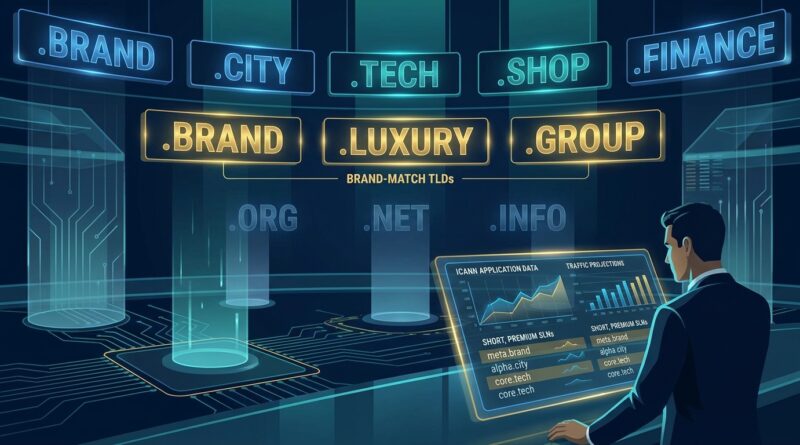
The Quiet Gold Rush In Brand‑Match TLDs: Why Owning The Right Extension Could Be Your Best 2026 Domain Play
Trying to make sense of the ICANN 2026 round right now feels a bit like standing in a supermarket cereal aisle with 400 brightly colored boxes and no clue which one is actually worth buying. That frustration is real. Every new extension pitch sounds exciting on the surface, but not every application has the bones to become a real market. The quiet money is not always chasing the flashiest string. It is often looking at brand match top level domains 2026 candidates and tightly focused category extensions that have a clear buyer, a built-in audience, and a believable plan to get names into use. If you are an investor, founder, or domain operator, the trick is not spotting what sounds cool. It is spotting what can sell second-level names for years, not just for launch week. That means reading applications like a business plan, not like a press release.
⚡ In a Hurry? Key Takeaways
- Brand-match and category-match TLDs with real distribution plans are the strongest 2026 opportunities, not the noisiest applications.
- Read each applicant for three things: who will actually register names, how they will be sold, and whether the operator has a reason to keep investing after launch.
- A pretty string alone is not value. If there is no clear renewal base and no path to active usage, it may be a vanity project.
Why the smart money is getting quieter
The first reaction to a new TLD round is usually the same. People rush to broad, catchy words. Travel. Shop. Web3-style buzz terms. The logic seems obvious. Bigger word, bigger market.
But that is not always how money is made.
The more interesting part of this cycle is how many serious players are studying narrower strings with a built-in reason to exist. A brand-match extension can work because one company has the budget, the customer base, and the motive to make it visible. A category-match extension can work because an entire trade, membership group, or business type can understand it in two seconds.
That is the heart of the brand match top level domains 2026 story. Value is moving toward extensions that can answer one simple question. Who will actually use this?
What a brand-match TLD really signals
A brand-match TLD is usually tied to a specific company, product family, or tightly controlled ecosystem. Think less random speculation, more strategic ownership.
Why that matters
If a known brand applies for its own extension, it may not create a huge open registration market. But it can still signal value in three ways.
First, it shows long-term commitment. Applying for a TLD is not cheap, quick, or casual.
Second, it shows likely real-world usage. The operator may use it for campaigns, support portals, secure logins, product lines, or regional naming.
Third, it can create halo opportunities nearby. Investors cannot usually buy the brand itself, but they can study adjacent category terms, supplier niches, campaign formats, and likely user habits that spill into other extensions.
That is where people miss the play. The gold rush is not always inside the brand TLD. Sometimes it is in understanding what that application tells you about naming demand around it.
Category-match TLDs may offer the better investor angle
For most readers, category-match strings are where the practical opportunities sit.
Why? Because these are the extensions that can support a second-level aftermarket. If an extension lines up with a real trade, service type, or business identity, you can imagine actual end users buying names under it.
Good examples follow a simple pattern:
- A clear business category
- An audience that already spends on identity and marketing
- A registry with a believable way to reach those buyers
That last part matters more than people think. A perfect string can still fail if nobody knows it exists or if the launch is badly handled.
How to read between the lines of a 2026 application
This is where many investors get lost. They see the string. They do not study the machinery behind it.
1. Look for distribution, not just desire
The strongest applicants usually have a path to market before the first domain goes live. That could mean registrar relationships, existing customer bases, reseller channels, associations, or direct brand traffic.
If the application reads like, “People will want this because it is a great word,” be careful.
If it reads like, “We already serve 80,000 businesses in this niche and will offer names as part of onboarding,” now you are paying attention.
2. Check whether the operator has staying power
Some applicants want a trophy. Others want an actual registry business.
Ask yourself:
- Is this operator funded well enough to survive a slow start?
- Do they have registry experience, or strong partners who do?
- Do they sound prepared for compliance, abuse handling, and marketing over several years?
A weak operator can sink even a good string.
3. Watch for a clear registration story
Who is supposed to buy second-level names under this extension?
If the answer is vague, the opportunity is vague.
If the answer is specific, such as clinics, creators, attorneys, local contractors, luxury retailers, or members of a trade group, that is much better. You want a registry that can point to a real customer, not an imaginary mass audience.
4. Separate ego projects from market projects
Some applications exist because a company wants to say it owns a TLD. Fine. But that does not make it investable.
A vanity project often has these warning signs:
- No obvious plan for broad usage
- Little reason for others to register beneath it
- Marketing language that is all vision and no numbers
- No sign of channel partners or launch strategy
A market project usually explains who the buyers are, how names will be priced, and how awareness will be built.
The real question: will this create second-level demand?
This is the part too many domain conversations skip.
An extension is only interesting to most investors if it creates good second-level opportunities. That means names people can actually picture buying and renewing. Not just launch-day curiosity. Ongoing use.
For example, a category-match TLD tied to a profession can produce strong combinations if businesses naturally want names like city.category, firstname.category, premiumservice.category, or book.category.
You are looking for naming patterns, not just a nice suffix.
This is also why timing matters. If you want to get ahead of the wave, it helps to study launch mechanics early. Our piece on The Pre‑Launch Landrush: How To Grab The Best Names In New gTLDs Before They Even Exist is useful here because the best names are often spoken for long before the average buyer even hears the extension is coming.
Three signs a 2026 TLD could hold long-term value
It solves a naming problem fast
The best extensions make sense instantly. No explanation needed. If a small business owner sees the extension and immediately understands how to use it, that is a strong sign.
It fits existing buying behavior
Some industries already spend freely on domains, lead generation, local search, and brand polish. Those groups are more likely to register and renew names. That is your renewal engine.
It has room for premium inventory
Can you easily picture desirable names under it? Short names. Location names. Service names. Credibility words. If yes, the extension may support both registry revenue and aftermarket interest.
Three signs it may die on the vine
It is clever but not useful
Cute ideas get press. Useful ones get renewals.
It depends on mass adoption without a mass channel
If success requires millions of people to change habits, the applicant needs a huge distribution engine. Most do not have one.
It lacks a reason to renew after year one
Launch spikes are common. Durable usage is rare. If a registrant is likely to ask, “Why am I still paying for this next year?” that is a problem.
How founders can use this, even if they are not domain investors
This is not just a domainer story.
Founders should watch the brand match top level domains 2026 wave for market signals. If a major company applies for a very specific string, that can reveal where they are placing bets. If an industry-focused extension has a serious operator behind it, it may open a cleaner branding path than fighting over expensive .com leftovers.
Just do not confuse possibility with urgency. You do not need to chase every new extension. You need to watch the ones that match your audience and your business model.
My simple filter for evaluating a new application
If you only remember one framework, use this one:
- Meaning: Does the extension instantly make sense?
- Market: Is there a clear buyer group?
- Machine: Is there a real way to sell and support it?
If all three are strong, keep watching.
If one is shaky, be selective.
If two are weak, move on.
At a Glance: Comparison
| Feature/Aspect | Details | Verdict |
|---|---|---|
| Brand-match TLD | Usually backed by one company with a clear motive, budget, and planned usage, but often limited open registration potential. | Strong signal of strategic value, weaker direct aftermarket play. |
| Category-match TLD | Targets a defined industry or user group and can support many practical second-level registrations if distribution is solid. | Best mix of usability and investor opportunity. |
| Vanity application | Looks exciting on paper but lacks buyer clarity, launch channels, or long-term operating commitment. | Treat with caution, even if the string is attractive. |
Conclusion
The best 2026 domain play may not be the loudest one. ICANN’s 2026 application window is open right now, and hundreds of proposed extensions are fighting for attention. That creates a lot of noise, and a lot of bad assumptions. The edge comes from slowing down and asking better questions. Who is behind the application? How will names actually reach users? Is there a real base of businesses or customers who will register and renew? If you focus on applications with true distribution, real operating intent, and obvious second-level naming potential, you put yourself ahead of people who are still chasing headlines. That is far more useful than another generic “new gTLDs are coming” summary. It gives you a practical way to sort signal from hype while the window is still open.