The Quiet .CO Price Shock: How To Turn Today’s Renewal Hike Into A One‑Time Buying Opportunity
If you hold a stack of .co domains, this one stings. A lot of founders and investors woke up to the .co domain price increase 2026 and had the same reaction: wait, renewals cost how much now? That frustration is fair. .co has long been the “close enough to .com, but still clean and brandable” option for startups, SaaS projects, and short domain bets. When the registry price goes up, the damage is not just emotional. It changes the math on every name you own. The mistake most people will make is simple. They will grumble, leave auto-renew on, and keep carrying weak names out of habit. That is exactly why this moment can actually help you. A permanent renewal hike creates a one-time chance to clean house, keep the best .co names, drop the passengers, and come out with a portfolio that is cheaper to hold and stronger to sell.
⚡ In a Hurry? Key Takeaways
- The .co domain price increase 2026 means weak .co names are now more expensive mistakes, so review every renewal instead of auto-renewing by default.
- Use this price hike as a forced portfolio audit. Keep only names with clear resale, brand, or build potential over the next 2 to 3 years.
- This is not a reason to panic-sell good .co domains. It is a reason to cut low-conviction names and protect cash for stronger assets.
What actually changed with .co renewals
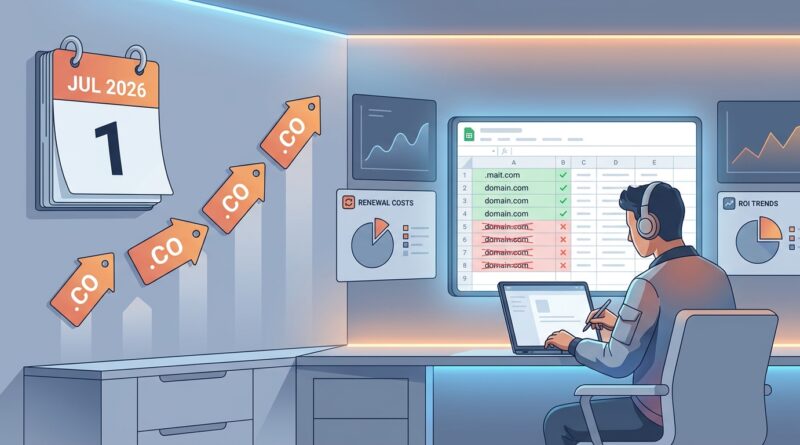
The short version is simple. Registry-level pricing for .co went up from July 1, 2026. Your exact renewal bill may vary by registrar, because each company adds its own markup, promos, and transfer pricing. But the important part is this: your carrying cost is now permanently higher than it was before.
That matters more than many people think. A domain is not a one-time purchase. It is an annual commitment. If a name was only “maybe worth keeping” before, a higher renewal price can push it into “not worth it at all.”
This is why the .co domain price increase 2026 is not just a billing annoyance. It changes which names deserve a spot in your portfolio.
Why this hits .co holders harder than they expect
.co has always lived in an interesting middle ground. It is more brandable than many alternative extensions. It is shorter and cleaner than a lot of new gTLDs. But it still does not have the default trust and type-in advantage of .com.
That means .co works best when the name is strong enough to overcome the extension premium in the buyer’s mind. A great one-word .co, a sharp startup brand, or a clean SaaS fit can still make sense. A mediocre two-word hand-reg with no clear end user? Much less so.
When renewals rise, average names get squeezed first. Premium quality names can usually absorb the extra cost. Borderline names cannot.
Turn the renewal pain into a buying opportunity
Here is the part most people miss. Every broad price increase creates two things at once: panic and neglect.
Panic makes some owners drop names they should probably keep.
Neglect makes others keep names they should clearly drop.
If you stay calm and use simple math, you can benefit from both. This is where the opportunity is.
Opportunity 1: Prune weak names without guilt
A lot of domain investors hold names because of old optimism. “Maybe someone will want it.” “Maybe this keyword gets hot.” “Maybe I can list it and forget it.”
Higher renewals force honesty. That is healthy.
If a .co name has gone two years with no serious inbound interest, no clear buyer profile, and no realistic build plan, the price hike gives you permission to let it go. You are not failing. You are stopping a small annual leak before it becomes a larger one.
Opportunity 2: Upgrade into fewer, better .co names
Once weaker holders start trimming, better names can quietly become available through drops, aftermarket listings, or private outreach. This is the one-time opening. Instead of paying renewals on 20 shaky names, you might be better off holding 5 strong ones.
That is a much healthier position if your goal is resale, startup use, or long-term brand value.
Opportunity 3: Use the money you save to buy conviction
Let’s say dropping ten weak .co names saves you hundreds per year. That savings can fund:
- one stronger aftermarket .co
- a good .com alternative for your project
- more runway for a domain you are actually building on
- renewals for names with real inbound history
That is a much smarter use of cash than feeding names you do not really believe in.
A simple test for every .co you own
If you are staring at a portfolio and not sure what to do, use this quick filter.
Keep it if:
- it is short, clear, and easy to say out loud
- it matches startup, SaaS, creator, finance, or tech branding naturally
- you can name at least 3 realistic end users
- it has had real inquiries, even if no sale happened
- you would still want to own it if renewals rise again later
Drop it if:
- you need to explain why the name is good
- the keyword trend has cooled off
- it depends on wishful thinking more than buyer demand
- it is a low-quality two-word combo with weak brand feel
- you would not buy it again today at the current renewal cost
That last question is the most useful one. Would you buy this name again today, knowing what renewals now cost? If the answer is no, that tells you a lot.
Use math, not gut feeling
This is where many investors get tripped up. They focus only on what they already spent. That money is gone. What matters now is future carrying cost.
Ask yourself:
- What will this name cost me to hold for 3 years?
- What is the realistic sale price?
- How likely is a sale, not in fantasy, but in real life?
- What else could I do with that renewal money?
If a name costs you significantly more to hold and still only has a tiny chance of a small sale, the answer is pretty clear.
This is also a good time to revisit adjacent extension strategy. If you are tracking AI-related names, for example, it is worth reading The .AI Spillover Effect: How Non‑AI TLDs Are Quietly Winning On AI Keywords. It is a useful reminder that strong keywords can still perform outside the obvious extension, but only when the fit is real and the carrying costs make sense.
What founders should do differently from investors
Founders and domain investors should not react the same way.
If you are a founder
If your .co is your active brand, product, or customer-facing site, do not panic over a reasonable renewal increase. For a real business, the domain renewal is usually tiny compared with design, hosting, payroll, ads, or software tools.
Your key question is not “Is renewal annoying?” It is “Would changing domains cost more than staying put?” For most active businesses, yes, it would.
So if the domain is central to your brand, keep it. Then lock in multiple years if pricing and cash flow make sense.
If you are an investor
You need to be much stricter. You are not buying identity. You are buying probability. A higher renewal cost lowers the margin for error. Your standard should go up.
In plain English, “pretty decent” .co names just became more dangerous to hold in bulk.
Should you renew early, transfer, or wait?
A few practical moves can help.
Check multi-year renewals
Some registrars may still give acceptable pricing on multi-year renewals. If you own a top-tier .co you fully expect to keep, adding years now can reduce future hassle.
Compare transfer pricing
Do not assume your current registrar is still competitive. Some registrars keep transfer-in deals or lower renewal pricing than others. A quick comparison can save real money, especially if you hold more than a handful of names.
Turn off blind auto-renew
Auto-renew is useful for names you absolutely must not lose. It is terrible for names you forgot to question. Review first, then renew with intent.
The biggest mistake to avoid
Do not respond by deciding all .co domains are suddenly bad. That is too broad and too emotional.
Good .co names can still be valuable. Startups still like short, sharp brands. Builders still want clean naming options when the .com is unavailable or unrealistic. The issue is not whether .co is dead. It is whether each specific .co earns its annual cost.
That is a very different question.
At a Glance: Comparison
| Feature/Aspect | Details | Verdict |
|---|---|---|
| Weak .co holdings | Low inquiry history, unclear buyers, average branding, now facing higher annual renewals | Best to drop or sell cheaply |
| Strong .co assets | Short, memorable, startup-friendly names with clear end users or active use | Worth keeping, and possibly renewing for multiple years |
| Portfolio strategy after the hike | Shift from holding many “maybe” names to fewer high-conviction domains | Smartest long-term move |
Conclusion
The .co domain price increase 2026 is annoying, yes. But it is also useful if you treat it like a decision point instead of a punishment. The best move is not to renew everything on instinct or dump everything in frustration. It is to do the boring, profitable thing. Review each name. Run the math. Keep the .co domains that still make sense. Cut the ones that only survive on hope. This helps the community today because the price change is live right now, not theoretical, and most people are still making decisions on gut feeling instead of math. If you reframe this permanent cost increase as a one-time chance to prune weak names and consolidate into higher-conviction .co assets, you protect your downside now and put yourself ahead of slower investors who will only notice the damage when their carrying costs pile up next year.