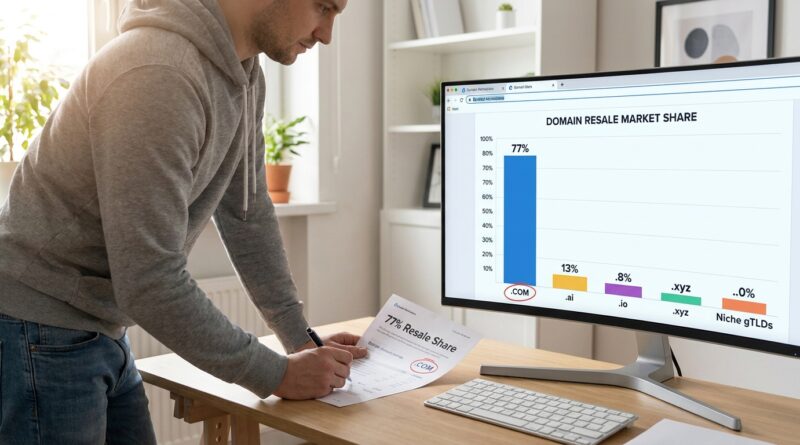
The 77% Signal: Why .COM’s Quiet Resale Dominance Should Change How You Pick Every Other Extension
You are not imagining it. Every few months, domain chatter swings to a fresh obsession. AI names. New extensions. The next gTLD round. Founder-friendly alternatives to .com. Yet when you look at what actually sells on public marketplaces, .com still keeps showing up like the dependable shop on the corner that never needs hype. That disconnect is frustrating, especially if you are trying to make smart bets with a small budget. You do not want to overpay for .com if a non-.com can work. But you also do not want to fill your account with names that sound trendy and never resell. The useful question is not “what extension is exciting?” It is “where is money actually changing hands?” Right now, the signal is hard to ignore. If roughly 77% of meaningful resale activity keeps clustering around .com, that should change how you judge every other extension you buy, hold, or skip.
⚡ In a Hurry? Key Takeaways
- .com is still the resale leader by a wide margin, so non-.com buys should be treated as selective bets, not default picks.
- Before buying any extension, check recent marketplace sales, average price bands, and buyer type instead of trusting promo buzz.
- The biggest money leak is carrying weak names for years, so prune low-demand domains fast and keep cash for extensions with proven exits.
The 77% signal matters more than the hype cycle
If most aftermarket demand still lands on .com, that tells you something simple. Buyers are voting with real money, not with social media excitement.
That does not mean every .com is good. Far from it. Plenty of bad .com names will never sell. But it does mean .com still has the deepest buyer pool, the strongest instinctive trust, and the easiest story for a founder, broker, or investor to tell.
For anyone researching com vs other domain extensions resale value 2026, this is the key point. You should not start by asking which new extension might explode. Start by asking how much weaker the resale market becomes the moment you leave .com.
Why .com keeps winning quietly
It is still the default in people’s heads
Say a brand name out loud and most people will type .com without thinking. That habit is old, but it still matters. It lowers friction for buyers and makes .com easier to justify in a boardroom or startup budget meeting.
More end users understand it
A startup founder may love a clever .xyz or .ai. A local business owner, buyer at a mid-sized company, or traditional investor may not. The broader the buyer pool, the better your odds on resale. .com benefits from that broad appeal.
It has a cleaner exit path
This is the part many small investors miss. A domain is not only about whether you like it. It is about whether someone else can picture owning it later. .com usually gives buyers the least explaining to do.
What this means for non-.com extensions
It does not mean “never buy them.” It means stop treating them like equals when the market does not.
Think of non-.com extensions as specialist tools. Some are useful in the right job. A few have real momentum. But they need stricter filters because they usually have less buyer depth.
For example, if you are watching app-focused naming trends, The Silent .APP Gold Rush: Why Mobile‑First Founders Are Grabbing These Domains Before The Next gTLD Wave Hits makes sense as a niche case study. That is different from assuming every alternative extension has the same resale chances.
How to reverse engineer extension choices from live resale patterns
This is the practical part. If you want to avoid junk inventory, work backwards from sales behavior.
1. Check where sales are happening now
Look at live marketplace feeds, reported sales databases, broker newsletters, and investor forums that discuss recent closes. You are not looking for one giant headline sale. You are looking for patterns.
Ask:
- Which extensions appear again and again?
- What price range is realistic, not aspirational?
- Are sales mostly to startups, brandable buyers, local businesses, or other investors?
2. Separate retail sales from investor flips
This is a big one. A sale from one domainer to another is not the same as a real end-user sale. End-user demand is what gives an extension life. If an extension mostly changes hands inside the investor crowd, be careful.
3. Study sell-through, not just top prices
One six-figure sale can fool people for months. What matters more is how often decent names actually move. A smaller but steady resale market is more useful than a flashy outlier.
4. Watch renewal drag
Some extensions carry higher renewals. That changes the math fast. A domain that looks cheap to buy can become expensive to hold if it sits unsold for years.
5. Match extension to buyer behavior
.ai may make sense for an AI startup. .app can fit mobile products. Country-code domains can work in strong local markets. But if you cannot picture the exact buyer and why they would prefer that extension over .com, slow down.
A simple way to grade any extension before you buy
Use this quick test.
The “three yes” filter
- Yes, there are recent comparable sales. Not from years ago. Recent.
- Yes, there is a clear end-user pool. You can name the buyer type immediately.
- Yes, the holding cost is reasonable. Renewals will not eat you alive while you wait.
If you do not get three yeses, the extension is probably a speculative side bet, not a core holding.
Common mistakes founders and small investors make
Buying the extension before the name
People fall in love with the idea of an extension and then force bad keywords into it. That is backwards. A strong name in a weaker extension can still struggle. A weak name in any extension usually dies quietly.
Confusing startup chatter with mass demand
Tech circles are loud. The actual buyer market is much bigger and much less online. What feels hot on X or in founder Slack groups may be tiny in real resale terms.
Holding too many “maybe” names
This is where budgets get wrecked. Ten average names with annual renewals can do more damage than one slightly expensive but much stronger domain.
Ignoring opportunity cost
Every weak renewal is money you cannot use on a better .com, a stronger niche extension, or your actual business.
So should you only buy .com in 2026?
No. But .com should be your measuring stick.
If a non-.com name is not clearly better priced, better targeted, or better suited to a real buyer group, .com remains the safer resale choice. Not because it is glamorous. Because it still has the best odds of being wanted later.
That is the part people miss. Quiet dominance is still dominance.
Practical buying rules you can use this week
- Make .com your default assumption unless the use case strongly argues otherwise.
- For every non-.com you consider, pull at least five recent comparable sales.
- Avoid extensions where the sales history is mostly old, thin, or based on one-off headlines.
- Set a renewal budget cap and stick to it.
- Drop names that no longer fit clear resale demand. Do not keep them out of guilt.
At a Glance: Comparison
| Feature/Aspect | Details | Verdict |
|---|---|---|
| Resale demand depth | .com still attracts the broadest mix of founders, businesses, brokers, and end users in most marketplaces. | Strong advantage for .com |
| Non-.com upside | Some extensions like .ai, .app, or select country codes can work when the buyer niche is obvious and recent comps exist. | Use selectively |
| Holding risk | Thin sales data, smaller buyer pools, and higher renewals can turn speculative names into long-term dead weight. | Biggest danger outside proven patterns |
Conclusion
If you have felt pulled between domain hype and domain reality, the current resale picture offers a helpful reset. The point is not that every .com is a winner or that every other extension is doomed. It is that value still flows unevenly, and .com keeps taking the biggest share. That should shape your decisions. Use live resale patterns as your map. Be tougher on non-.com purchases. Cut weak holdings faster. When budgets are tight, this kind of reality-check matters. It helps founders and small investors avoid extension fads, stop hoarding junk names, and focus their cash on domains that have an actual shot at an exit.