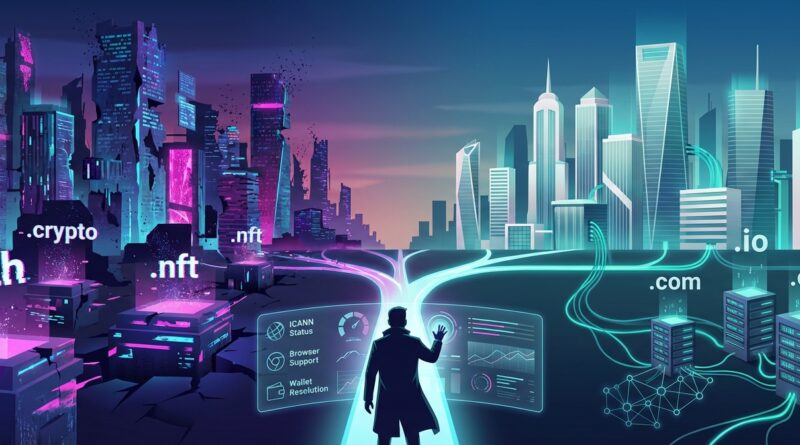
Web3 Domains Are ‘Dead’… So Why Are Hybrid Web2/Web3 TLDs Suddenly in Demand?
If you bought into .eth, .nft, or other pure Web3 names during the last hype cycle, you are not crazy for feeling whiplash right now. A lot of people were told these names would replace normal domains, become digital identity, and turn into premium internet real estate. Then the mood changed fast. Even some of the biggest names in the space are now admitting that pure Web3 domains have weak business use outside crypto circles. At the same time, money is moving toward something less flashy but more practical: hybrid domain models that work with the regular DNS system and still connect to wallets, blockchain records, and on-chain identity. That matters because the question for 2026 is no longer “Are Web3 domains the future?” It is “Which naming systems actually resolve in browsers, fit inside ICANN rules, and have a shot at real adoption?” That is where the market is quietly starting to split.
⚡ In a Hurry? Key Takeaways
- Pure Web3 domains are not gone, but for mainstream business use they are losing ground to DNS-based, browser-friendly options.
- If you are investing in names for 2026, start by asking whether the TLD works in normal browsers, sits inside ICANN rules, and has wallet features as an extra, not the whole product.
- The biggest risk now is holding names that only work inside one crypto app or one provider’s closed system. Portability and real resolution matter more than hype.
What just happened?
The short version is simple. The market finally started saying out loud what many users already felt in private.
Pure Web3 naming systems, especially the ones built outside the traditional DNS root, are great for certain crypto-native jobs. They can point to wallet addresses. They can link to decentralized profiles. They can act like usernames inside Web3 apps. But they have struggled badly at one very normal thing. Opening in the regular web, in the regular browser, for regular people.
That gap matters more than promoters wanted to admit. Businesses do not want to explain special wallet plugins to customers. They do not want support tickets from people asking why a domain only works in one browser extension. And they definitely do not want to build a brand on a naming system that sits outside the internet’s default plumbing.
So when major players start saying the quiet part out loud, the market listens. Not because Web3 naming has zero value, but because the business case has narrowed.
Why hybrid Web2/Web3 TLDs are suddenly getting attention
The new demand is going toward names that do two jobs at once.
First, they behave like normal internet domains. They can live in DNS. They can resolve in standard browsers. They fit more naturally into registrar systems, hosting setups, email, SSL, and search.
Second, they can still connect to wallet addresses, blockchain identity, token-gated services, or on-chain records. That gives them some of the upside people liked about Web3 domains, without asking users to leave the normal internet behind.
That mix is a lot easier to sell.
Think of it like this. Pure Web3 domains tried to build a new road system next to the highway. Hybrid providers are saying, “Keep the highway, add smarter exits.” Businesses prefer that every time.
Web3 domains vs DNS domains 2026. The real dividing line
If you want a useful filter, stop asking whether a domain is “Web3” or “not Web3.” That is now too vague to help.
Instead, ask these questions:
Does it resolve in standard browsers?
If the answer is no, mainstream adoption gets much harder. Browser resolution is not a nice extra. It is the front door.
Is it inside DNS or aligned with ICANN rules?
This does not guarantee success, but it lowers friction. It means less custom behavior, less user confusion, and a clearer legal and technical path.
Are wallet and on-chain features optional layers?
This is the sweet spot. If blockchain features improve a normal domain, great. If they replace the normal domain stack entirely, risk goes up.
Can the name move between providers?
Closed systems are dangerous. If your “domain” only works inside one company’s app, that is closer to a platform username than true internet property.
Why pure Web3 names hit a wall
There are still real use cases for ENS-style and similar systems. Let’s be fair about that. They work well for wallet identity, human-readable crypto addresses, and community signaling inside crypto ecosystems.
But investors got ahead of the actual demand.
A lot of people priced these assets as if every company, creator, and local business would soon want a blockchain-native name instead of a .com or other DNS domain. That never happened at scale. Most business owners did what business owners always do. They picked the option customers already understand.
The problem was not just technology. It was behavior. People know how domains work now. They type them into browsers. They expect email to work. They expect search engines and hosting platforms to recognize the address. If a naming system breaks those expectations, adoption slows down fast.
What hybrid providers are doing differently
The smarter operators seem to have learned three lessons.
1. They are starting with DNS, not trying to replace it
This is the biggest shift. Instead of saying “Web3 will kill DNS,” they are building products that sit on top of DNS or next to it in a way normal users can still understand.
2. They are selling utility, not ideology
Customers do not care about internet architecture debates. They care about whether the site opens, whether the email works, and whether the name helps them do business.
3. They are aiming at regulation and legitimacy
ICANN alignment, registrar partnerships, and standard browser compatibility are boring topics. They are also where durable businesses usually get built.
So, should domain investors double down or walk away?
Neither. They should sort.
This is not the moment to lump every blockchain-linked naming asset into one bucket and panic sell. It is also not the moment to keep buying anything with “Web3” in the pitch deck.
You need a cleaner checklist.
Names worth another look
TLDs and providers that are DNS-native or clearly moving toward ICANN-compatible structures. Names that can work in ordinary browsers. Providers treating wallet mapping and decentralized identity as value-added features, not the entire reason the domain exists.
Names to treat carefully
Extensions that depend on custom browser plugins, closed wallets, or one company’s naming gateway. Assets where resale value depends on crypto sentiment alone, not end-user utility.
Names that may become stranded
Any namespace with weak user growth, unclear legal footing, and no realistic path to mainstream browser support. If a name cannot escape its own niche, it can still have community value, but investor value gets much harder to defend.
A simple test for buyers in 2026
Before buying any domain tied to the Web3 story, ask:
- Can my mom type this into Chrome or Safari and reach a site?
- Can a business use it for normal branding without a tutorial?
- Is there a path to email, hosting, and search visibility?
- If the current provider disappears, does the name still have meaning and portability?
- Is blockchain making the domain better, or just making the sales pitch louder?
If you cannot answer those clearly, step back.
What this means for the next cycle
The next winners in digital naming probably will not look like the last cycle’s stars.
The old trade was simple. Buy the pure Web3 story and hope the world moved there. The newer trade is more grounded. Back naming systems that can live in the boring, messy, real internet while adding useful on-chain functions around the edges.
That is less exciting. It is also more believable.
For everyday users, this is actually good news. It means the future may not require choosing between old internet and new internet. The products gaining traction are the ones trying to bridge both.
At a Glance: Comparison
| Feature/Aspect | Details | Verdict |
|---|---|---|
| Browser compatibility | Pure Web3 domains often need special apps, plugins, or partner browsers. Hybrid DNS/Web3 names aim to open like regular domains first. | Hybrid has the stronger path to mainstream use. |
| Business utility | Businesses need websites, email, trust, and customer familiarity. Pure Web3 names work better as wallet identity than public business frontage. | DNS-first with optional Web3 features is safer. |
| Investment risk | Closed ecosystems and low portability increase the chance of stranded assets. ICANN-aligned, standards-friendly namespaces have fewer structural roadblocks. | Avoid buying hype without checking real-world resolution and portability. |
Conclusion
The useful takeaway here is not that Web3 domains are “dead” across the board. It is that the market finally started separating identity tools from true internet domains. That distinction got blurry during the boom, and a lot of investors paid for that confusion. The good news is you can still adjust. If you focus on DNS-native, ICANN-aligned, wallet-ready names that work in real browsers, you are playing a much stronger game than someone still betting on last year’s story. That helps right now because the narrative has flipped in public, but many buyers are still priced into old assumptions. Sort your holdings by actual usability, not branding. The names most likely to survive are the ones that fit the internet people already use, while adding just enough Web3 function to be useful instead of awkward.