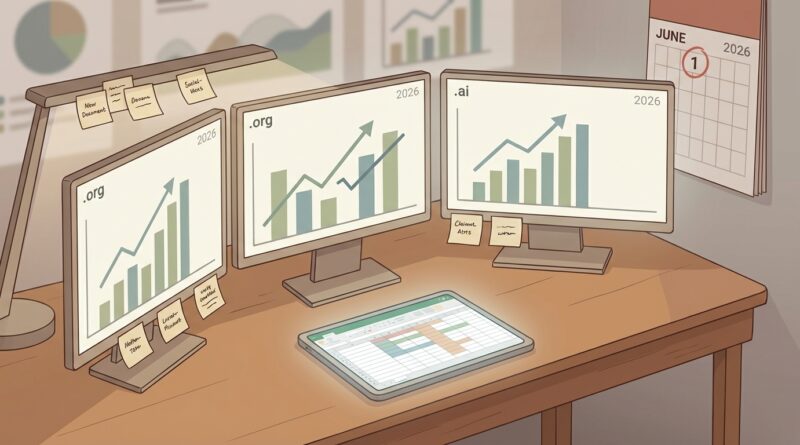
The Quiet Squeeze In Legacy TLDs: How .org And .ai Price Hikes Are Reshaping ‘Safe’ Domain Investments In 2026
If you hold domains for the long run, this is the part nobody warns you about. The sale price gets all the attention, but the renewal bill is what quietly eats your returns. That is why so many investors and founders are feeling squeezed right now. .org, long seen as one of the calmer and more predictable extensions, has a confirmed wholesale price increase coming June 1, 2026. .ai, which many buyers treated like a premium growth bet, has already become much more expensive to carry. Put those two things together and your “safe” portfolio can start looking a lot less safe.
The hard part is not just that prices are rising. It is that buyer demand is no longer rising in a straight line with them. Some names still deserve to be renewed. Others are turning into negative carry assets, where the annual holding cost is growing faster than the realistic chance of a sale. The good news is you do not need guesswork here. A simple numbers first review can tell you what to keep, what to drop, and what to swap before the next 12 months get more expensive.
⚡ In a Hurry? Key Takeaways
- .org and .ai are no longer “set it and forget it” holds. Renewal cost now has to be part of every buy and hold decision.
- Use a simple rule. If a name cannot justify 5 to 10 years of renewals with realistic sell-through odds, trim it now.
- For most investors, strong .com still offers the safest long-term carrying profile, while .org and .ai now need stricter quality filters.
What changed, and why people are nervous
The problem is not just one price hike. It is the loss of predictability.
.org built its reputation on trust, familiarity, and relatively sane carrying costs. It was never flashy, but that was the point. You could buy a good one, hold it, and not feel like the floor might move under you. The confirmed wholesale .org increase for June 1, 2026 changes that math. Not overnight, and not catastrophically, but enough to matter if you hold dozens or hundreds of names.
.ai is a different story. It surged on startup demand, speculation, and the broader excitement around artificial intelligence. But when renewal costs jump while buyer enthusiasm cools in parts of the market, the weakest names get exposed fast. A lot of investors are now staring at invoices and asking a very basic question. Is this name still an asset, or is it a bill?
The real issue is negative carry
This is the phrase more domain investors should use.
A domain becomes a negative carry position when the cost to keep holding it starts outweighing the realistic value of keeping it. That does not mean the name is worthless. It means the name is no longer pulling its weight compared with its annual cost.
A simple example
Let’s say you hold a decent but not amazing .org at $12 to $18 a year retail today, and that cost keeps rising over time. Over 10 years, even a modest annual increase can turn one harmless renewal into a serious carrying cost across a portfolio.
Now compare that with a .ai name renewing at a much higher level. If the name is not top-tier, a few years of renewals can equal or exceed what many mid-quality names would realistically sell for. That is how investors end up losing money on names they once felt great about.
.org price increase 2026 domain renewal strategy
If you are specifically trying to build a .org price increase 2026 domain renewal strategy, start here. Forget emotion for a minute. Use a three-bucket system.
Bucket 1: Keep
Renew .org names that meet at least two of these tests:
- Clear commercial or nonprofit use case
- Strong exact-match phrase or highly brandable term
- Past inbound interest, traffic, or existing revenue
- Comparable sales that still support your expected price
Bucket 2: Watch
These are names that are decent, but not obvious winners. Maybe they are clean two-word .orgs, niche community terms, or cause-related phrases with limited buyer pools. Keep them only if your total carrying cost stays small relative to your portfolio budget.
Bucket 3: Drop or swap
Drop weak .orgs that were bought because they felt “safe” rather than because they were truly good. Safety in domains does not come from the extension alone. It comes from end-user demand, pricing discipline, and how long you can hold without stress.
If you still like the keyword but hate the carrying cost, consider whether a stronger .com acquisition target or a lower-risk extension makes more sense. Not every keyword deserves to live in every TLD.
How to judge .ai without getting caught up in hype
.ai is not dead. Far from it. But it has become much less forgiving.
At the peak of the rush, investors could convince themselves that almost any decent tech phrase might find a buyer. That is much harder now. End users are still paying up for truly strong .ai names, but average inventory is getting squeezed from both sides. Renewals are high, and buyer selectiveness is rising.
Good .ai names still share a few traits
- Short and easy to say
- Direct fit for software, automation, models, agents, data, or developer tools
- Useful for a funded startup, not just a domainer
- Good enough that the buyer would plausibly choose it over a modified .com
Bad .ai names are easier to spot now
- Long two-word combinations with no urgency
- Trendy phrases that already feel dated
- Names with little startup fit outside speculative resale
- Inventory you would not buy today at the current renewal price
That last point matters. A smart portfolio review asks one blunt question. If I did not already own this, would I buy it today knowing the renewal cost? If the answer is no, your portfolio is trying to tell you something.
Run the numbers like a landlord, not a collector
This is where non-tech founders often make better decisions than hobby investors. They look at carrying cost with less sentiment.
Use this 5-step test
- Write down the true annual renewal cost for each domain.
- Estimate a realistic sale price, not your dream price.
- Estimate realistic sell-through odds over 5 years.
- Multiply the likely sale price by the likely chance of sale.
- Compare that expected value against 5 years of renewals.
Quick example
If a name might sell for $2,500, but only has a 1 percent annual chance of selling, its expected value is a lot lower than it first appears. If renewals are high, especially in .ai, the margin can disappear quickly. That does not mean every name needs a spreadsheet worthy of a hedge fund. It just means you should stop treating renewals as background noise.
Why “legacy” no longer means low risk
A lot of people hear “legacy TLD” and think stable, boring, dependable. Sometimes that is still true. But the old assumption that established extensions are automatically safe holds is getting weaker.
.org still has real strengths. It is trusted, familiar, and useful for nonprofits, communities, education, and mission-driven projects. But trust and affordability are not the same thing. If pricing keeps moving up while buyer demand stays selective, weaker names inside a respected extension can still become bad holds.
The lesson is simple. A good extension can reduce risk. It cannot erase it.
What founders should do differently from investors
If you are a founder using one domain for your business, this is less about portfolio theory and more about avoiding future pain.
For founders
If your brand is already built on a strong .org or .ai, do not panic. A price increase is annoying, but it is usually still cheaper than a rebrand. What you should do is lock in multiple years if your registrar offers a fair rate and you know the name is core to your business.
For investors
You do not have that luxury with every name. Your job is to cut the bottom 20 percent before it quietly drags down the top 20 percent. The bigger the portfolio, the more this matters. A few extra dollars per domain does not sound like much until you multiply it across 200 names you barely want anymore.
Practical keep, drop, or swap rules for 2026
Keep
- Top-tier one-word or very strong two-word .org names with clear end users
- High-quality .ai names that fit funded startup categories
- Domains with traffic, leads, or past serious inquiries
Drop
- “Pretty good” names with no inbound interest after years of holding
- Long-tail .ai names bought during the hype cycle
- .org names whose only selling point is that .org used to feel safe
Swap
- Trade three weak high-renewal names for one stronger lower-risk acquisition
- Move budget from speculative .ai inventory into proven commercial keywords
- Consolidate around quality, not quantity
At a Glance: Comparison
| Feature/Aspect | Details | Verdict |
|---|---|---|
| .org in 2026 | Trusted extension with confirmed wholesale increase on June 1, 2026. Still useful, but no longer a blind hold for average names. | Keep only the stronger inventory. Review all borderline names. |
| .ai carrying cost | Much higher renewal profile, with demand still strong at the top but softer in the middle and bottom tiers. | Great for premium names. Dangerous for speculative bulk holdings. |
| Best long-term strategy | Use expected value, realistic sell-through odds, and 5 to 10 year renewal cost before renewing. | Quality wins. Portfolio pruning is not weakness, it is risk control. |
Conclusion
The quiet squeeze is real. .org’s confirmed wholesale increase for June 1, 2026 and the recent .ai price jump are hitting renewal invoices right now, not in theory. That is why this matters today, especially for investors and founders who thought these names were safe long-term holds. The fix is not panic selling. It is a calm, numbers first review. Keep the names with clear demand. Drop the names that only looked good when renewals felt cheap. Swap weaker inventory for fewer, better assets if needed. If you do that now, you give yourself a much better shot at avoiding negative carry positions over the next 12 months and building a portfolio you can actually live with for the next 5 to 10 years.