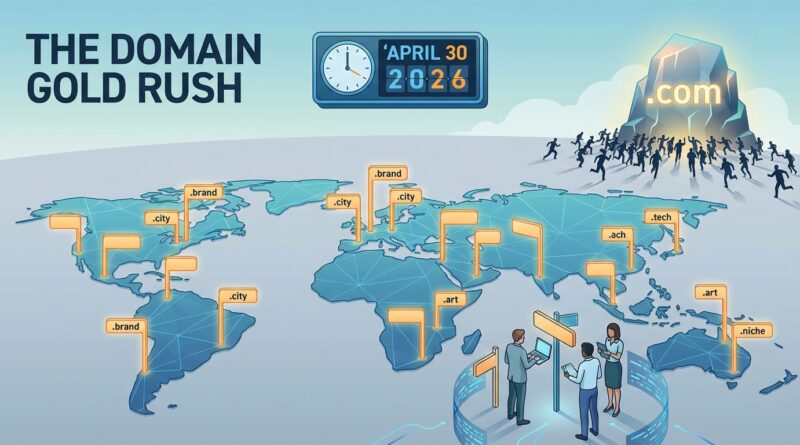
Seven Weeks To The Next Internet Land Rush: How To Quietly Profit From ICANN’s 2026 New gTLD Round Without Applying For Your Own TLD
The frustrating part about every new gTLD cycle is that the loudest voices are usually talking about the wrong thing. They focus on who might spend $227,000 to apply for a shiny new extension, while regular founders, brand managers and domain investors are left wondering what any of this means for names they can actually buy. That confusion is fair. Most people are not launching .yourbrand. They just do not want to miss the next wave of useful, scarce, and suddenly expensive domain inventory. With ICANN’s April 30, 2026 application window now locked in, the guessing stage is ending. We finally have a real clock to work with. That matters because the smart move is not applying for your own TLD. It is getting ready for what happens after the applications are filed, the shortlists become public, and future demand starts forming around sunrise, landrush, and early access windows.
⚡ In a Hurry? Key Takeaways
- The best ICANN 2026 new gTLD round opportunities for domain investors will come from tracking new extensions early, not from applying to run one.
- Start building a watchlist now for likely strings, target keywords, and launch phases so you can act during sunrise, landrush, and early general availability.
- Do not chase every new extension. Focus on strong use cases, likely end-user demand, and renewal economics before you buy.
Why this round matters even if you never apply for a TLD
Think of the 2026 round like a property map being drawn before roads are built. The real money for most people will not come from owning the whole town. It will come from knowing which streets will become busy first.
Once applications are submitted, the market starts to show its hand. You can see what strings are being pursued. You can spot which sectors are preparing to market heavily. You can also see which ideas look exciting on paper but may never gain enough real-world use to support good aftermarket prices.
That is the key point. New gTLDs do not create value just because they are new. They create value when businesses, communities, and marketers spend real money pushing them into public view.
The timeline regular buyers should care about
1. Application window opens on April 30, 2026
This is mostly relevant as a signal, not as a buying event. Once the window opens and closes, attention shifts from rumors to actual applicants and actual strings.
2. Application disclosures and shortlist analysis
This is where savvy buyers should get to work. When applicant data becomes visible, you are no longer guessing what might launch. You are building watchlists around likely launches, contested strings, niche sectors, and brand-sensitive areas.
3. Evaluation, objections, and delays
This part will test everyone’s patience. Some strings will move faster. Others will get stuck in disputes, contention sets, policy issues, or business problems. That gap matters. Faster-moving strings can create earlier registration windows and earlier aftermarket action.
4. Sunrise, landrush, early access, general availability
This is the part domain buyers know best. And it is where preparation beats speed. If you wait until a new extension is trending on X or showing up in founder group chats, you are late. The best names are often gone before broad public awareness arrives.
Where the real ICANN 2026 new gTLD round opportunities for domain investors may show up
Category 1. Community and membership-based strings
These are often overlooked because they sound narrow. But narrow can be good. If an extension maps cleanly to a real group with identity, trust, and a reason to use it, adoption can surprise people.
Examples could include profession-based, association-based, or cause-based extensions. A community string with active members can produce strong first-wave registration demand and better long-term retention than a generic string that nobody feels attached to.
Category 2. B2B niche strings
Most investors crowd into broad consumer terms. That leaves boring-looking sectors underpriced. But boring sectors often have budgets. Think industrial, compliance, logistics, supply chain, specialist software, or trade-focused naming.
If a new extension fits a sector where companies care about clarity more than coolness, there may be a small but serious market for exact-match names.
Category 3. Geographic and cultural strings with built-in demand
These can be tricky, but they are worth watching. A well-run geographic or cultural extension can attract local businesses, tourism operators, media, and advocacy groups. If the operator has a clear launch plan and community backing, there may be a real aftermarket, especially for obvious commercial terms.
Category 4. Defensive buying magnets
Some extensions will attract brand owners fast, even if the public never falls in love with them. That creates a different kind of opportunity. You are not betting on mass adoption. You are betting on trademark sensitivity and corporate caution.
That can support strong launch-period demand. It does not always support long-term investor value, so be careful. But if your timing is right, defensive pressure can matter in the early phase.
How to quietly front-run the market without gambling blindly
Build a shortlist before the market gets noisy
Create a simple spreadsheet. You do not need fancy tools at first. Track these fields:
- Proposed string
- Expected use case
- Likely registry operator
- Target user base
- Trademark risk
- Estimated launch sequence
- Keywords and exact-match domains you want
- Your max budget for each launch phase
This is boring work. It is also the work that gives you an edge.
Study the operator, not just the extension
The same string can perform very differently depending on who runs it. A registry with good distribution, sane pricing, registrar relationships, and actual marketing plans is worth far more than a clever string with weak execution.
Look for operators with a track record of getting names into use rather than just into shopping carts.
Watch for pricing traps
A lot of investors lose money by focusing only on registration day. The smarter question is what the carrying cost looks like in years two and three. Premium renewals, aggressive repricing, and weak renewal behavior can ruin what looked like a good buy.
This is where a broader portfolio mindset helps. If you have not read The Quiet Renewal Goldmine: Why High-Retention TLDs Are Becoming The Safest Bets In Domains, it is worth your time. The lesson applies here too. You do not really feel a weak extension when you buy it. You feel it when renewals stack up and end-user demand never quite arrives.
What to do during each launch phase
Sunrise
If you are a brand owner, this is your defensive window. If you are an investor, sunrise tells you something important. It shows where trademark holders are active and where commercial sensitivity is high. Heavy sunrise activity can signal an extension that brands are taking seriously.
Landrush
This is where discipline matters. Pick your targets ahead of time. Know your ceiling. It is easy to get carried away when several strong names are in play at once. Try to focus on terms with obvious end users, not just names that look cool to domain people.
Early access or early general availability
This phase often offers the best mix of access and price if you have done your homework. The market is still forming, but the panic has usually cooled a bit. Good buyers can still pick off strong names while everyone else is waiting for social proof.
General availability
By this point, many obvious names are gone. But not all value disappears. Good opportunities can still show up in local terms, service combinations, category modifiers, and names tied to emerging use cases that were not obvious on day one.
Three mistakes that will probably cost people money
Buying broad hype instead of specific demand
“This extension sounds huge” is not an investment thesis. You need a clear answer to who will use it, why they will pay for it, and how they will market around it.
Ignoring contention and delay risk
Some promising strings may take much longer than expected to become available. If your strategy depends on a perfect timeline, you are building on sand.
Treating all new gTLDs like one market
They are not. Some will be brand-heavy. Some will be community-led. Some will be pure speculation magnets. Some will quietly become practical homes for real businesses. Those are very different bets.
A practical framework for the next seven weeks and beyond
If you want a calm, realistic plan, use this:
- List 20 to 40 likely strings you think could matter.
- Cut that down to the 10 with the clearest end-user case.
- For each one, write the 25 names you would actually try to buy.
- Mark which are likely sunrise risks, landrush targets, and GA backup names.
- Set a total budget now, before launch excitement hits.
- Review registry pricing rules and renewal terms before buying anything.
- Be ready to skip weak launches. Missing a bad opportunity is a win.
That last line is important. You do not need to own a piece of every trend. You need to own the right names in the few extensions that get real traction.
At a Glance: Comparison
| Feature/Aspect | Details | Verdict |
|---|---|---|
| Applying for your own TLD | High cost, long timeline, heavy legal and operational burden. Best suited to major brands and well-funded applicants. | Not the play for most readers. |
| Tracking applicant shortlists early | Lets you spot likely high-interest strings, registry quality, niche sectors, and timing before the crowd reacts. | Best low-cost edge. |
| Buying during launch phases | Can secure strong names before full public demand arrives, but pricing and renewals need close attention. | Good strategy if you stay selective. |
Conclusion
The useful thing about this moment is not the hype. It is the visibility. The 2026 round timeline is finally clear enough that regular buyers can plan instead of guess. That gives the Domains Tip community a real chance to get ahead of the market by tracking applicant shortlists, spotting niche and community strings that bigger portfolios may ignore, and mapping out buying plans around sunrise, landrush, and early general availability. You do not need to spend a fortune or chase every new extension. You just need a watchlist, a budget, and the patience to wait for the right launch windows. If you do that, you have a much better shot at holding the right names before the marketing money arrives and before everyone else notices what is becoming valuable.